Inflation is silently reducing the value of your money every day. Learn how inflation works, why your savings lose purchasing power, and practical strategies to protect your wealth and stay financially secure in 2026 and beyond.
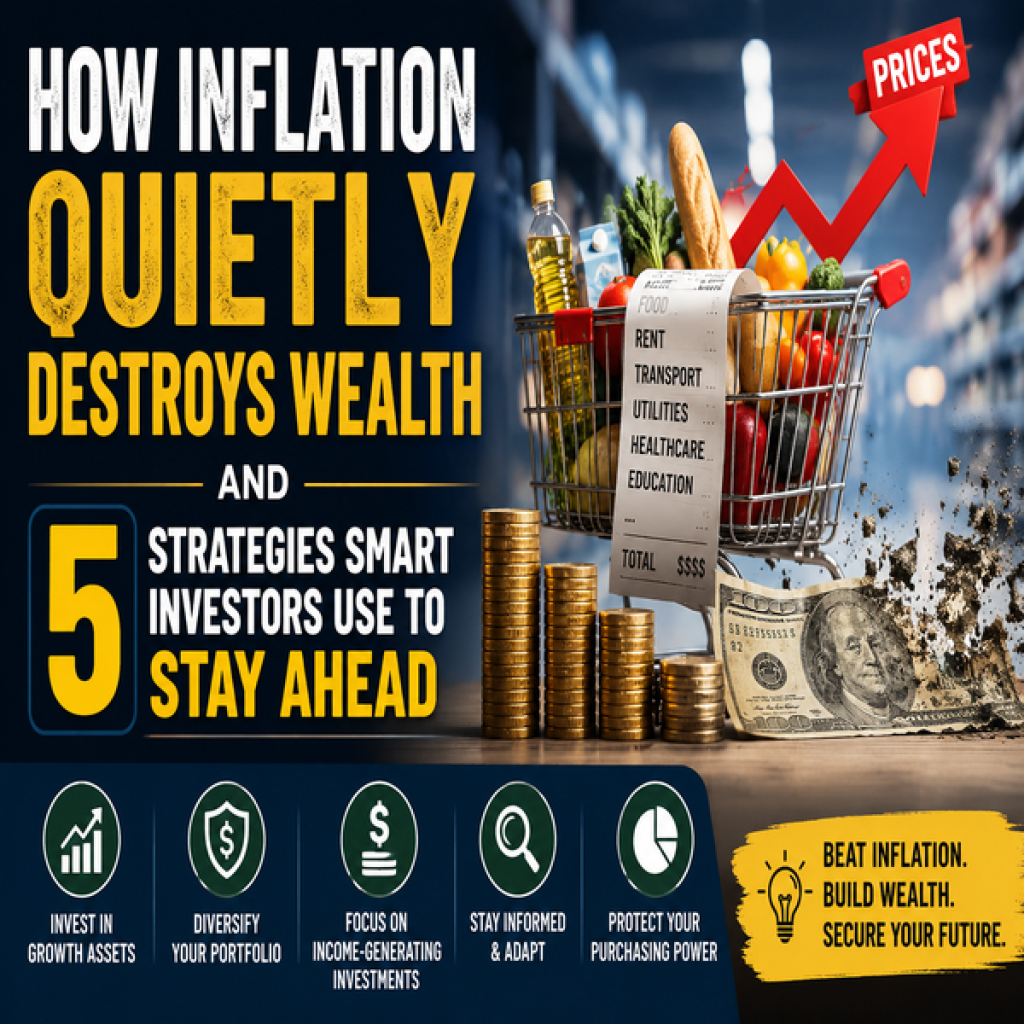
How Inflation Quietly Destroys Wealth and 5 Strategies Smart Investors Use to Stay Ahead
If you have been to your local grocery store not too long ago, then you may be able to feel your face drop when the total comes up at the checkout. Or maybe you observed that getting full tank has become more akin to taking out a small personal loan? If you are shaking your head, you are not the only one. You my friend, are facing the power of inflation - that sneaky invisible gust of wind rising beside you.
And inflation is a term that brings both concerns, eye-rolls and downright confusion. But it might start with the price of eggs.
And can affect your overall financial planning for a very long time.
Don’t panic. Inflation is terrifying, until it is not… Once you know what inflation is doing and have a simple strategy to handle it (and implement it), inflation becomes easier to live with. The most important aspect is a plan you can follow repeatedly.
Let us take it step by step and work out how you can keep your money working for you hard earned.
What the Heck is Inflation, anyway?
Inflation is the rate of change of the general price level of goods and services in a country. Money acts as a store of value and purchasing power, therefore, when prices rise, the value of money decreases.
When inflation occurs, money in your wallet becomes less valuable over time, bringing fewer real goods to your door for each dollar you spend.
That same $100 bill may have originally purchased a couple of bags of groceries, a pack of gum or a bottle of cologne. But on Wednesday, it could buy a couple of bags of groceries, a pack of gum and a bottle of cologne. The same piece of paper and ink carries different values.
But it is precisely this force that can sabotage the best laid plans. An example: Someone two years ago established a savings plan they were sure would deliver, only to have inflation sap some of the actual value. At 3%, or more, it only takes that kind of relentless climb to render projected returns worthless.
Your 5-Step Strategy for Managing Inflation
There is no avoiding the effect of inflation, but it can be easily tackled with the right mindset. Instead of watching your savings shrink, keep your hard-earned money working for you. Read on for 5 ways to fight the rising cost of living. Keep reading to discover how to keep your money safe.
1. Buy Things That Grow (Hedging with Real Assets)
You probably have cash in your wallet. As time goes by, that cash loses value every day. What if you could exchange that cash for assets that actually gain value as prices rise? There is a name for these type of investments in the financial world, they are called "inflation hedges."
Hate hearing that “cash is king”? Think about Monopoly. You don’t win the game by clutching all the bills in your hand, folded neatly in your wallet. Instead, you win by possessing the green houses and red hotels. Real life works much the same way.
The real asset is, arguably, the most classic form of real asset i.e. real estate. The cost of living increases, home values and rental prices rise. Even with a 30-year fixed mortgage, housing can be net beneficial during periods of inflation.
But what if you are not ready to buy a house? What if you live in an expensive city where a down payment seems impossible?
Don't worry you are not locked out of this strategy.
You can try Real Estate Investment Trusts or REITs for short. Think of a REIT like people investing in a big building, an apartment complex, or a huge shopping mall together. You can buy shares in your brokerage account or IRA just like buying a stock.
And by doing this, you own a piece of real estate that makes money. The REIT gets rent when inflation goes up and then gives you that extra money as dividends.
You get the parts of being a landlord without having to fix problems like a leaky toilet, at 2:00 AM.
2. Let the Stock Market Do the Heavy Lifting
We hear ad nauseum to “Invest in the stock market”, but few seem to understand why this is particularly important during periods of high inflation. The answer is simple: Stock prices represent the Price of Pricing Power.
Start by thinking about the typical flow of your day, from waking up and reaching for your phone first thing in the morning to stopping for a coffee or whatever snack you like between work and then making a purchase online or in-store.
So, what do these massive corporations do when inflation hits and the cost of raw materials, the cost of shipping and labor increases? Answer: they do not absorb the increased cost by decreasing their corporate profits. Instead, they increase the prices that consumers have to pay for the products of these large, powerful, and successful corporations.
Amazon, Apple, and other major digital companies have raised their prices by 50 cents for individual purchases and are increasing the annual cost of Amazon Prime by $20. Although these increases may garner some complaints and media attention, consumers are ultimately unlikely to revolt – and will probably continue to spend $4.50 on lattes and pay the increased annual fees for Prime services that they value.
They have increased their prices, therefore they have increased their revenues. Therefore, their earnings increased. And, historically speaking, over the long term, when your earnings increase, your stock price goes up.
In this new economy, it’s no longer enough to be a passive consumer; we should all strive to be owners too. And it’s the owners of the companies that are growing the economy. By investing in a diversified portfolio of stocks, you are literally riding alongside the companies of the economy. As businesses increase prices to keep pace with inflation, as their earnings climb to pay for the higher cost of raw materials, you also profit. And, historically, the stock market has outperformed inflation over the long-term, although, as we all know, there is nothing guaranteed in the short-term.
3. Hack Your Budget
Inflation does not evenly affect all parts of life. For example, if gasoline prices rose by 30% but your internet subscription remained at $25 per month then prices would have increased 10% for one category of expenditure as against 30% for another. Inflation therefore demands that one cannot fix budget for 2019 and expect it to be relevant for subsequent periods. One has to be proactively engaged in managing one’s finances. One is the CEO of one’s finances. Therefore, one must treat them with the seriousness and the respect that a CEO affords his or her enterprise.
Let's Hack Your Budget this weekend! Turn budgeting into a fun weekend activity.
Tomorrow / this weekend, take about an hour to go through your finances (with wine, of course). Spend the time reviewing your last two months of bank and credit card statements. Print them out (yes, print them out). Get three highlighters: Green, Yellow, and Pink.
• Green funds daily necessities such as: Rent, groceries, utilities, and insurance.
• Yellow indicates activities and things that truly bring you happiness; like going to your favorite gym class, your weekly date nights with bae, or your subscription to Spotify!
• Pink: Wait, I'm still paying for this?!
Work through your Statement Preview, item by item, highlighting each charge. As you review your Statement Preview, you’ll typically see a few Pinks here and there that you may not recognize. These may include recurring charges for unused or forgotten subscription services and other small automated payments that add up over time.
We've been going through the Pink expenses to ensure we're getting value from them and starting to cancel those that aren't.
Let's discuss the Greens next. These are a must on most courses but can still be reduced in cost i.e. reviewing your insurance plan, do the current service providers offer the best rate or current promotions.
And the Yellows – these are all about enjoying yourself but cutting back in some areas. The trick to this category is to think about how your spending habits could change. As inflation goes up, so will the essential items you need to buy such as groceries. By cutting back on other areas of non-essential spend you should be able to find enough to offset this increase to The Greens. For example, if your grocery bill increases by £100 per month to cover inflation you could save that money by choosing one less restaurant meal out and replacing it with a relaxed night in and a home cooked meal.
Keeping today’s costs up-to-date in your budget will save you from overdrafts and the hit to your savings that comes with covering the unexpected expenses of everyday life.
4. Hide Your Raises from Yourself (Outsmarting Lifestyle Creep)
You've read that cash is losing value, so the simple maths is to save more of it. But I know that's much easier said than done, especially when everything seems to cost more these days.
The biggest secret of all is that as a human being, you will get used to having more money. But by the time you get completely comfortable, some young whippersnapper will have made a bunch of money off of you. This rule holds true for any successful distribution of wealth in history.
Most people feel as though their pay raises barely keep up with inflation. After years of hard work you graduate to a middle-class lifestyle and expect that your pay will rise accordingly. When you finally get the big promotion or the big raise (2% to 5%), you think about what you can purchase. An extra 5% to increase your salary may seem modest, but can actually mean a big new car, the ultimate dream pad, or a better diet for your dog.
You put in extra hours and land a promotion, working hard for that well-deserved raise from $50,000 to $52.50k per annum, equivalent to a 5% increase. So far, so good. What’s going wrong? It has cost 10% more to sustain the same lifestyle. In the interim, you have gained increments in pay but not corresponding gains in personal financial freedom. This is what financial experts call lifestyle creep.
To keep ahead of your money and spend only what you want to, adopt what I call the 48 Hour Rule. This means that whenever you receive a raise, bonus, promotion, or tax refund, you can celebrate for 48 hours, but then you have to stop. Treat yourself to nice dinners and buy things you like (if you do decide to buy it, make sure you were thinking of it on purpose).
Before those 48 hours turn into days turn into weeks, commit 50% to 75% of your increased income towards savings or investments automatically through HR portal, online banking etc.
When you get a raise of $200 per month, automate $150 of it into your investment account before you even see the remaining $50 per month in your checking account. It won’t even hurt because you never got to enjoy the money in the first place. But what you will get is significant long-term wealth as you continue to save a greater and greater percentage of your increasing income.
5. Take the Free Money (The Magic of the Employer Match and Compound Interest)
Remember, if your employer offers a retirement plan, you need to be taking full advantage of it. An employer match is literally free money. For example, if your company matches 5% of your salary and you contribute 5%, you just made an immediate, guaranteed 100% return on investment. There is no hedge fund manager, no real estate deal, or new crypto token that can guarantee a 100% return on day one.
You might be surprised at how quickly your hard-earned money can start working for you. After you receive your pay into your account, your money can begin earning one of the most powerful forces in finance: compound interest.
Another crucial concept for your financial growth is compound interest, meaning not only will you earn interest on money deposited, but also interest on that interest. As your interest turns into money, it can start to generate even more interest, working similar to a snowball which picks up weight and momentum as it continues down the hill, growing in power the longer it goes.
If you start putting away $200/month at age 25 and earn an 8% return on investment, by the time you reach 65 you will have put away a total of $96,000 and accumulated $698,000. This other $600,000+ or so is pure growth from the magic of compounding interest.
Take $200/month deposited over time and imagine the result. Without realizing it, you've deposited $100/month. However, when combined with compounding and your employer's match, you've walked away with roughly $700,000. That is how you beat inflation by using time, money, and an employer who is willing to match your free money to amass a wealth pile that is unreachable to rising prices.
Tomorrow takes a few minutes to log in to your employee benefits portal to make sure you are contributing enough to receive 100% of the employer match. It’s an easy way to build your retirement savings.
Key Takeaways
It’s a fact of life that we live in an economy with a degree of inflation. This can be very unsettling, and for most of us, it means things we buy cost more each year. While that can be painful, having a solid financial plan means inflation need not be disastrous.
Most people who have built up a decent fortune have at least one secret that they will be eager to share with you. The problem is that almost all that advice will be rubbish, so it will be easier just to ignore it. What does matter is that you build up your wealth with intent and get your money to work for you. You can do nothing about the inflation rate, the inevitable up-and-downs of the economy, the booms, and the busts. You can, however, learn to make your money work for you during all of these, by being thoughtful and careful with your savings, your investments, and your consumption in the face of rising earnings.
Why does your salary disappear so quickly? Explore the everyday spending habits, financial pressures, and small expenses that can turn ₦150,000 into a mid-month money crisis.
Why do we spend money trying to look successful? Explore the psychology behind lifestyle spending, social pressure, and the hidden cost of looking financially fine.
Having enough money to buy something doesn’t always mean you can afford it. Learn a smarter way to evaluate purchases, protect your finances, and spend with confidence.