You Were Paid Yesterday. What Happened?
Why does your salary disappear so quickly? Explore the everyday spending habits, financial pressures, and small expenses that can turn ₦150,000 into a mid-month money crisis.
Loading...


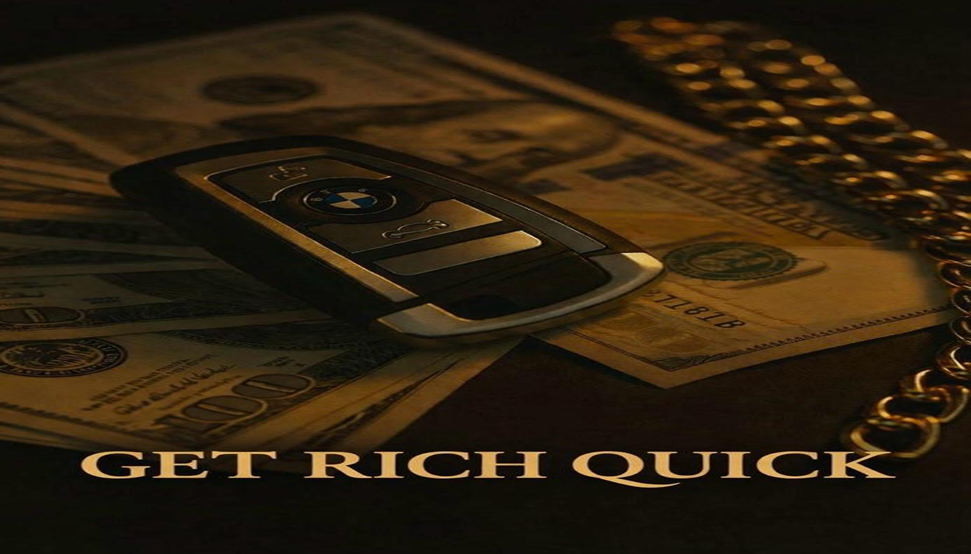
In a world full of “guaranteed” crypto profits, passive income blueprints, and overnight millionaire promises, it’s easy to fall into the trap of chasing quick wealth. This article breaks down five major get-rich-quick red flags that can destroy your finances in 2026. Learn how to spot scams, avoid costly mistakes, and focus on building real, sustainable wealth instead of chasing shortcuts.
Table of contents [Show]
We’ve all heard the ancient advice: Build your house on the rock, not on the sand. It sounds lovely in a sermon, but in the real world of 2026, most of us are out here trying to build a five-story luxury condo on top of a pile of half-eaten avocado toast, high-interest credit card debt, and a "guaranteed" crypto-miracle that some guy in a rented Lamborghini told us about on the internet.
It’s exhausting, isn't it?
We live in a culture that treats "getting rich" like a microwave dinner. We want the result without the labor. We want the harvest without the planting. And honestly, I get it. I’ve been there. I’ve sat there at 2:00 AM, eyes glazed over, scrolling through "Passive Income Blueprints" that promise to turn my $50 into $50,000 while I sleep. I don’t think there’s any other way to describe vanity than my precious wasted time.
I understand better now that the "why" behind your work matters more than the work itself. When you make financial moves out of desire and purpose, you’re planting seeds and building something that stands. But when you make financial moves out of fear (fear of being left behind, fear of not having enough, fear of missing out, and so on), you’re not building a life. You’re just practicing how to lose money faster. In fact, you’re frantically gathering straw against the wind, wondering why your house keeps blowing over every time the economy so much as sneezes.
If you’re tired of the "busy work" of staying broke, it’s time to take a walk through the Hall of Shame. These are the five financial red flags that keep us running in place, and if you see them in your life, it’s time to stop, drop the shovel, and rethink your foundation.
1. The "Guaranteed Return" Idol

I once had a friend who spent three hours explaining how he was going to be a millionaire by buying 'micro-cap' crypto coins while he was currently borrowing twenty bucks from me for a pizza. That was my first lesson in Financial Red Flags. People love to talk about growth, but they don't want to talk about the toxic habits that keep them stuck in a loop of broke.
I see a lot of these kinds everywhere. A random stranger on the internet who just discovered "investing." Suddenly, their profile picture is them standing in front of a rented Lamborghini, and their captions are all about "crushing the game" and "breaking the matrix." And then, the pitch hits. It’s always the same: “It’s a guaranteed return. 20% every month, literally zero risk. Why are you still working a 9-to-5 when the algorithm is doing all the heavy lifting for you?”
If you’ve heard this, you’ve met the "Guaranteed Return" Idol. And if you’ve ever felt that tiny, nagging tug of FOMO. That weird, sinking feeling that maybe, just maybe, he knows something you don’t, then congratulations. You’re human. But you’re also dangerously close to setting your hard-earned money on fire.
Let’s dismantle this. Say you’re standing in a forest, and someone walks up to you and says, "Hey, I’ve got a magical tree that grows $100 bills, but I’m going to let you have it for the low price of $500," your survival instinct should be screaming. You don't think, “Wow, what a generous soul! I better get in on this!” Instead, you think, “This person is trying to rob me, and they aren’t even being creative about it.”
Most times when we talk about finance, we stop thinking like logical human beings and start thinking like people who want to win the lottery without buying a ticket. We want to believe that there is a secret backdoor to wealth that the "9-to-5 peasants" don't know about. The "Guaranteed Return" Guy knows this. He feeds on that specific type of anxiety. The fear that you’re working too hard for too little, and that everyone else is getting ahead while you’re stuck in the mud, he sells you a shortcut.
Believe it or not, here is the biblical truth about the economy: The harvest requires planting. There is no way to bypass the seasons. You cannot plant a seed on Monday and expect to harvest a full orchard on Tuesday. Anything that claims to circumvent the natural laws of growth is either a miracle or a fraud and spoiler alert, the internet is not in the business of performing miracles.
The moment you hear the word "guaranteed" attached to an investment, you should treat it like a flashing red siren. In the world of finance, the relationship between risk and reward is like gravity: you can’t escape it. If you want high returns, you must accept high risk. That’s the rule.
When someone promises you a high reward without the risk, they are lying to you. Period. They aren’t offering you an investment strategy; they are offering you a Ponzi scheme. They are taking money from the people who joined today to pay the "returns" to the people who joined yesterday. It looks like growth on the surface, but it’s just a house of cards waiting for the wind to blow. And when it finally collapses because it always does, the "Guaranteed Return" Guy won’t be there to take your call. He’ll be on to his next venture, probably selling a "proprietary AI trading bot" that definitely would lose all your money.
You might be thinking, “I’m too smart to fall for that.” And maybe you are. But these guys are masters of the psychological "nudge." They use fancy jargon, they show screenshots of fake bank statements, and they talk about "disrupting" industries. They make you feel like you’re on the inside of a secret club.
It feels good to be in the know, right? It feels better to think you’re a "visionary" investing in the next big thing than to be someone who just puts money in a boring old index fund and waits ten years.
But building real wealth is boring and it takes time. It’s putting a chunk of your paycheck into a boring account every month, month after month, year after year. It doesn’t involve grainy selfies in parking lots, and it doesn't involve "guarantees" that sound like they came from a casino advertisement.
True growth is built on the rock of consistency, not the shifting sands of a "sure thing." If you find yourself tempted by a pitch that sounds like it’s too good to be true, ask yourself one question: If this guy has the secret to infinite money, why is he begging for mine?
If he has the magic, he doesn't need your $500. He wouldn't be talking to you. He’d be busy being the richest person on the planet. Truth be told, the moment you start looking for a "backdoor" to riches because you’re scared of being left behind, you’ve already lost the game.
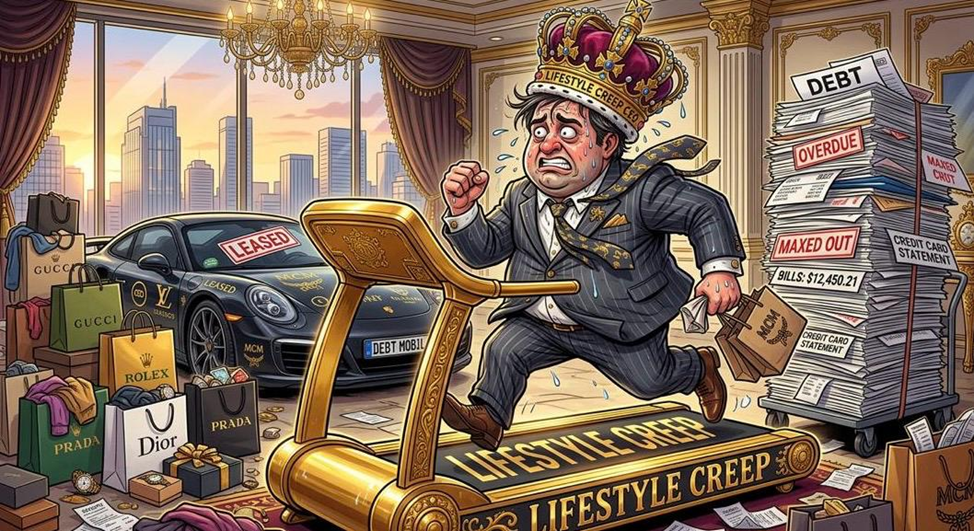
Let’s have a real talk about the Lifestyle Creep "CEO." You know exactly who I’m talking about. Maybe you’ve even seen them in the mirror after that last raise. It’s the person who gets a 10% bump in salary and immediately decides their life requires a 15% upgrade in luxury to match their new status. They’re the "CEO" of their own personal brand, constantly polishing the exterior of a skyscraper that’s built on a foundation of debt and premium subscriptions.
The most dangerous phrase in personal finance isn't "I'm broke." It’s "I deserve this." We use it as a magic wand to justify everything. You worked hard for that promotion? You deserve the newer car. You survived a brutal week of back-to-back meetings? You deserve the $200 dinner. You’ve been "grinding"? You deserve the latest gadget that just dropped.
It feels human. It feels like a reward for your labor. But know this; “I deserve this" is the anthem of the broke. When you treat your income like a reflection of your worth rather than a tool for your future, you’re playing a losing game. You’re trying to fill a hollow feeling with shiny things. The "CEO" mentality tells you that you need to look the part to be the part, so you lease the luxury car to look like a high earner, even if your savings account is crying for mercy. You’re spending money you haven't even really "kept" yet to impress people who, frankly, are too busy worrying about their own leased cars to care about yours.
Think about the actual mechanics of this and I love to call this the "Empty Suit" Effect. If you earn $5,000 a month and spend $5,000 a month, you are a master of zero. If you get a raise to $6,000 and immediately jump your spending to $6,000, you haven't moved one inch forward. You’ve just increased your "burn rate", the speed at which you’d go bankrupt if your boss decided to let you go tomorrow.
That is not a CEO move. That is the move of an employee who is terrified of their own shadow.
A real CEO is the kind who builds a business that lasts and doesn't spend their first year’s profits on a mahogany desk and a fleet of private jets. They reinvest, shore up the foundation and make sure the company can handle a storm. Yet, when it comes to our own lives, we do the exact opposite. We spend our "profits" before we’ve even finished building the walls of our house. We are living in a stage set. It looks great from the front, but there’s nothing holding it up from behind.
If you’re constantly upgrading your lifestyle to match your income, you are effectively chained to your desk. You can’t take a risk, you can’t pivot to a new career, and you can’t handle a sudden emergency. You ask why? because your lifestyle is an expensive monster that needs to be fed every single month. You aren't the boss of your life; your lifestyle is the boss of you.
3. The "I’ll Figure It Out Later

The is perhaps the most relatable character in this entire Hall of Shame because, let’s be honest, looking at your bank account after a holiday weekend feels a lot like opening a graded math test you didn't study for. You know the news isn't good, so you decide that if you don't look at the paper, the grade doesn't actually exist.
The problem with playing the ostrich in finance isn't just that you’re missing the view but that, while you’re busy pretending nothing is happening, the situation is quietly getting worse. Hiding from your finances doesn't pause them.
Look let’s be real. Your banking app is probably the most terrifying thing on your phone. It’s the one you open with one eye squinted, praying the number staring back at you isn't going to ruin your entire week. We’ve all played the "Ostrich" game: you swipe your card for that last-minute dinner, you feel that tiny, sharp twinge of panic in your gut, and then you just don't check your balance for a week.
We’re masters at justifying this. We find ourselves saying things like, "I’m just stressed, I’ll deal with this when I get a raise," or "I’ll fix the debt once my tax return hits." It feels like a kindness to yourself to avoid the "negativity" of a low balance or a mounting credit card statement.
But you aren't protecting your peace. You're just feeding your anxiety. There is nothing more draining than the unknown. When you don't know your numbers, every single swipe of your card is a gamble and every push notification from your bank feels like a personal attack. You're living in a constant, low-level state of dread, waiting for that one moment when the house of cards finally collapses. I define this as just hiding from your own life.
This is where all that "Rock vs. Sand" talk starts to make sense. If you’re trying to build something that lasts, you need to know what you're working with. People who build on rock don't guess how deep their foundation is. They know exactly where the cracks are, they know what materials they have, and because of that, they don't panic when the wind picks up.
If you want to be a functional adult and by functional, I mean someone who doesn't break into a cold sweat at the grocery store checkout, you have to pivot. You have to stop being a victim of your finances and start being a steward. You grow with this mentality that “I’m the one in charge of what I’ve been given”. You can’t take care of something you’re too scared to look at. It’s like trying to grow a garden while refusing to check for weeds. You're just setting yourself up for a harvest of thorns.
The question is, how do you stop being an ostrich without having a total meltdown?
Let's start by avoiding running from your bank account. I know it’s scary, but it’s not the monster you think it is. You don't need a finance degree to get a grip on things and you definitely need to stop hiding from your own money.
Start by just looking at the numbers. Don’t beat yourself up, and don't feel like you have to fix everything in five minutes. Just look. Once you face the reality of what’s going on, you’ll start seeing the "leaks". Those $12 streaming services you forgot about or the $6 daily habits that are quietly draining your account.
Numbers lose their edge the second you name them. When you know exactly what you owe, it turns from a terrifying, nebulous "problem" into a simple math equation. And math? Math you can solve.
Also, try setting up a 15-minute "Money Date" with yourself once a week. It’ll feel awkward at first and you’ll probably want to throw your phone across the room but by the fourth week, you’ll realize your "financial crisis" was just a messy room that needed a bit of a clean-up. Quit burying your head in the sand. The view is a lot better from the surface, even if there’s a little bit of work to do.
When we talk about being a "Subscription-Addicted Servant," we’re not talking about the tools you use every single day to build your craft or stay educated. We’re talking about the "zombie" subscriptions. the ones you’ve forgotten that add no real value to your life, and the ones you’re paying for simply because it’s more annoying to cancel them than it is to just let them drain your account.
Most of us have a banking history that’s become nothing more than a relentless wall of automatic deductions. Apple, Spotify, Netflix, Amazon Prime, the gym, the meal kit, that random software you used once six months ago, the iPhone upgrade program, the car lease. It is wild how completely normal it has become to just rent our entire existence.
The math is simple. For instance, selling you a product once is a terrible business model. Why sell you a DVD for fifty bucks when they can bleed you for fifteen bucks a month for the rest of your natural life? They call it the "subscription economy," but it’s just a modern trap. It’s designed to be frictionless. It’s only ten dollars here, twelve dollars there. It’s death by a thousand tiny cuts.
I recall my friend Peter. He was burning out in a corporate job in Lagos that he absolutely hated, convinced he couldn't afford to quit because he needed the salary to cover his lifestyle. When we sat down and combed through his statements, we found nearly ₦150,000 a month in recurring charges he’d completely forgotten about. Gym memberships to luxury clubs he hadn't stepped foot in for years, three different international streaming services, and a bunch of "pro" app subscriptions that were eating his naira every single month. He was working extra hours and dealing with massive stress just to feed the subscription monster, when that money could have been his ticket to finally starting that side business he’d been dreaming about for years.
The dark side of that "convenience" is this: when you subscribe to everything, and at some point, even forget about them, you own absolutely nothing. And when you own nothing, your baseline cost of living (the amount you have to generate just to keep the lights on) becomes astronomically high.
This is exactly how you slowly become a servant.
When you have a massive chunk of your income hitting automatic deductions before you’ve even had your first cup of coffee on the first of the month, you’ve handed over your leverage. You can’t quit that toxic job because you have to feed the subscription monster. You’ve essentially become a middleman for your own pay check, funnelling money from your employer straight to companies that don't even know your name. They are literally banking on your exhaustion.
As the writer Nassim Taleb once said, "The three most harmful addictions are heroin, carbohydrates, and a monthly salary." The ultimate flex in today’s world isn't having every premium service or the newest leased car. The ultimate flex is having a low overhead, buying things outright and keeping them.
Because when your monthly baseline is low, you don't have to be a servant to anyone. You aren't working to pay for your lifestyle, you’re working to build your freedom. And having the choice to say "no" to a job, a boss, or a situation you hate? That is the only real wealth there is.

Have you ever noticed that you suddenly want something like a new pair of sneakers, a specific phone, or a certain trending bag after you see someone else with it?
There’s a name for this and it is called Mimetic Desire. It sounds like a fancy science term, but the idea is simple. A guy named René Girard, who spent a lot of time thinking about human nature, realized that we aren't as "original" as we think. We don't usually want things because of what they do for us. We want them because we see other people wanting them.
Think of it like being in a room full of people who are all looking at the same wall. Even if there’s nothing interesting there, you’re going to look, too, just because everyone else is.
If Comparison Fever is the illness, Mimetic Desire is the virus that causes it. It’s a two-part trap that works like this; Comparison Fever is just the surface-level frustration you feel every day. But the real engine driving that frustration? That’s Mimetic Desire.
Here’s why they’re such a dangerous duo:
Mimetic desire is why you start looking at other people in the first place. You see a peer or a creator who looks "successful" (they have the clothes, the travels, the status), and your brain tells you: "That person has the secret to a good life. If I copy them, I’ll be happy too." You’ve now adopted their goal as your own, even if it has nothing to do with who you are.
Once you've adopted their goals, the fever kicks in. You start constantly measuring your progress against theirs. You’re no longer asking, "Am I happy with my life?" You’re asking, "Am I doing as well as they are?" Because you’re chasing their version of success, you’re stuck in a state of permanent dissatisfaction. You’ll never feel like you’ve "arrived" because their version of success is a moving target. As soon as you catch up to where they were, they’ve already moved on to the next trend.
When I tell you this, I’m speaking from a place of genuine concern, because I’ve seen first-hand how this mindset cripples high-level potential. We often talk about "hustle culture" as if it’s purely about how hard you work or how many hours you clock in, but that’s only half the equation. The other half is how you manage your headspace. When you allow your self-worth to be dictated by the curated, high-definition highlight reels of others. When you fall for that trap, you lose your leverage and by leverage, I mean the ability to walk away from a bad situation, a toxic job, a compromised contract, or a lifestyle that no longer serves your long-term vision. If you spend too much just to look successful, you are basically trapping yourself. You’re trading your freedom for an image that isn't real and end up just trying to please everyone else instead of living your own life.

Why does your salary disappear so quickly? Explore the everyday spending habits, financial pressures, and small expenses that can turn ₦150,000 into a mid-month money crisis.
Why do we spend money trying to look successful? Explore the psychology behind lifestyle spending, social pressure, and the hidden cost of looking financially fine.
Learn how credit scores work, why they matter, and practical steps you can take to improve your credit score and make borrowing more affordable.